
TDCJ State Release Paths
The Texas Department of Criminal Justice is a statewide prison system, not a Real County jail. A person sentenced in a Real County case may leave an outside county jail and enter TDCJ custody. The county transfer entry closes one local custody event, while the TDCJ admission begins another. A later TDCJ exit may be parole, mandatory supervision, sentence discharge, bench transfer, or movement to another authority.
Those outcomes have different effects. Parole is discretionary supervised release from a prison sentence. Mandatory supervision is a statutory supervised-release form, with Board review for applicable cases. Discharge generally means the sentence reached its controlling end, but the record should still be checked for another cause or detainer. A bench transfer can place the person in another jail or court process without a community return.
| TDCJ event | What it establishes | What to check next |
|---|---|---|
| Parole | Prison custody ended under supervision | Parole status and assigned office |
| Mandatory supervision | Supervised release under Texas law | TDCJ status and release certificate |
| Discharge | TDCJ sentence administration ended | Maximum expiration and other custody |
| Bench or agency transfer | TDCJ physical custody changed | Receiving court, jail, or agency |
Confirm a TDCJ Release
Use the official TDCJ offender search with a TDCJ number or state identification number when known. A name search works best with exact name, race, and sex. The result can display current location or status, projected release date, maximum sentence date, and parole eligibility information. Search fields can change as calculations and legal events are posted, so save the retrieval date and recheck an uncertain result.
- Match the person by identifier and birth details, not name alone.
- Record the displayed status, location, projected date, and maximum expiration date.
- Look for an actual release date and release type rather than treating a forecast as final.
- Check whether parole or mandatory supervision remains active.
- Compare the TDCJ information with the signed Real County judgment and any receiving-agency record.
A person who no longer appears in an easy public-name result may still have a releasable history. Use TDCJ telephone or email information services with the full name and TDCJ number, or full name plus exact date of birth. Ask specifically for actual last release date and type, not merely a current status.
TDCJ Release Records Contact
TDCJ basic information is available by telephone or email. Telephone inquiries require a TDCJ or SID number, or an exact date of birth. The basic email route asks for the full name and TDCJ number or date of birth and age. It may provide current unit, projected release date, maximum expiration date, parole eligibility date, and prior release information when available.
936-295-6371 or 800-535-0283
8 a.m.–5 p.m. Monday–Friday
pia@tdcj.texas.gov
For the underlying record, send a focused Public Information Act request to TDCJ Public Information Request, P.O. Box 4017, Huntsville, TX 77342, or use PIA@tdcj.texas.gov. Ask for incarceration history, actual last release date and release type, release certificate, releasing unit or location, maximum-expiration or discharge date, and parole or mandatory-supervision status. TDCJ lists hand delivery at 2 Financial Plaza, Suite 600, Huntsville.
Ordinary paper copies are posted at $0.10 per page. Requests above 50 pages may add allowable personnel, overhead, and delivery charges. TDCJ provides an itemized estimate above $40 and may identify a less costly alternative. The basic-information email page says photographs are not supplied through that service, so do not assume an image will accompany a release response.
TDCJ Versus Real County Custody
No TDCJ unit was verified inside Real County. TDCJ is a destination system for a person sentenced and transferred from county custody. The Real County Sheriff or receiving county jail should document the handoff. TDCJ then controls the state admission, classification, unit history, release processing, and later state-prison exit record.
Keep the records separate. The Real County judgment establishes the sentence and any jail credit. The county jail ledger documents local custody and transport. TDCJ administers the prison term and calculates dates under the controlling sentence, credits, parole rules, detainers, and later legal changes. One record cannot safely substitute for the others.
Real County publishes no online criminal-case portal. County and District Clerk functions share the contact for D'Ann Roosa, P.O. Box 750, 146 South U.S. Highway 83, Leakey, telephone 830-232-5202. Ask which clerk holds the cause, then request the judgment, sentence, commitment, credit provision, docket, mandate, and later orders. These documents help explain why TDCJ received the person and whether a later date changed.
Read TDCJ Release Dates
TDCJ defines projected release date as an estimate of when release may occur if the person is not granted parole and does not lose credits or receive another sentence. It is not a promise. Maximum sentence date is the calculated end of the sentence under the information then recorded. Parole eligibility marks when review may become possible, not the date release will happen.
Release calculations can move after corrected jail credit, disciplinary action, a new conviction, concurrent or consecutive sentence treatment, detainers, court orders, or changes in applicable law. The Board of Pardons and Paroles decides parole matters; TDCJ Review and Release Processing performs work after approval. For pre-vote status, BPP lists 844-512-0461. After approval, Review and Release Processing lists 512-406-5202.
The useful evidence set is the original judgment, sentence start, jail-credit provision, TDCJ time record, Board decision where applicable, release certificate, and actual exit entry. Calculate nothing from the sentence length alone. A forecast can guide a follow-up date, but only the custodian's final record proves when and how the person left.
Note: Recheck future dates after sentence, credit, disciplinary, or Board events because the displayed estimate may change.
TDCJ Release Supervision
A release on parole or mandatory supervision means prison confinement ended while the sentence continues under supervision. TDCJ offender information may identify a parole office assignment or status. Use the Parole Division directory and the individual record. Do not choose an office solely because it looks closest to Leakey, since approved residence plans, special caseloads, and administrative boundaries matter.
TDCJ's county cross-reference assigns Real County to the Del Rio District Parole Office, Region IV, at 903 East 12th Street, Del Rio, TX 78840, telephone 830-775-4516. Confirm the actual assignment before relying on that routing. Ask only for public verification of status and office. Personal reporting directions should come from the supervising officer.
Probation is different. A Real County court can impose community supervision without a TDCJ prison term. The judgment and supervision order, held in the local court file, establish that status. Do not read a probation record as proof of TDCJ release, and do not read TDCJ parole as local probation.
TDCJ Release and Detainers
A TDCJ exit does not always mean unrestricted freedom. Another Texas county, a federal authority, or immigration officials may receive the person. Ask TDCJ for the release type, releasing location, and destination. Then verify intake in the next system. A county warrant, federal writ, or immigration detainer can explain why a public result shows departure from TDCJ while family contact does not occur.
If ICE receives the person, use the Online Detainee Locator System with an exact A-number and country of birth or the biographical search fields. If USMS receives the person, use the federal docket, detention order, actual contract jail, and USMS inquiry because the Marshals Service has no comparable historical public locator. Never treat absence from TDCJ as proof of release into Real County.
The same caution applies to a blue warrant or revocation event after parole. An absconder or warrant status describes a claimed supervision problem, not a finding that the original release never happened. Verify the present status and any return to custody through TDCJ and the responsible authority.
TDCJ Information Request Fields
The official TDCJ information page lists the fields available through its basic inquiry channel and explains the projected-release concept.
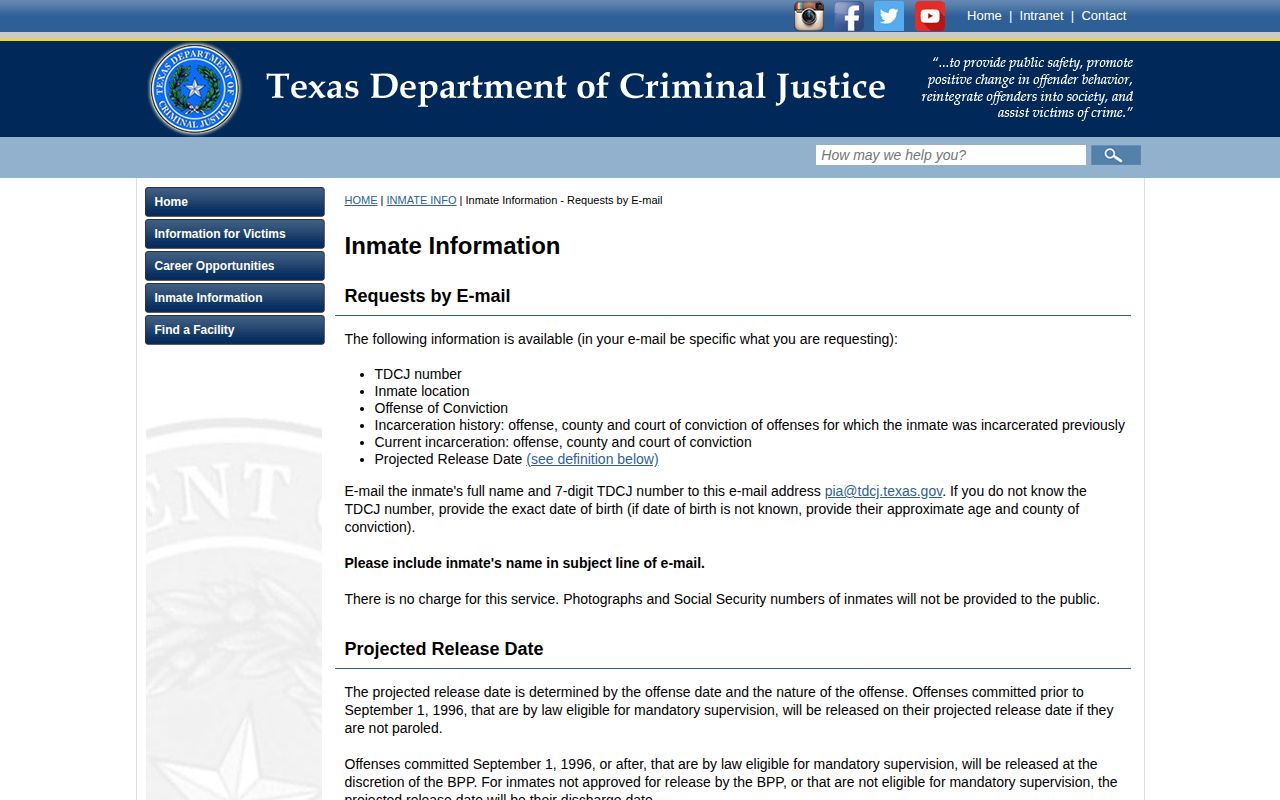
Use the screenshot as a guide to terminology, then retrieve the live record. The page may be updated, and the person-specific result remains the controlling source for current status.
TDCJ Sentence Record Checks
When the search and judgment seem inconsistent, check for multiple cause numbers, concurrent or consecutive terms, corrected credit, and a later sentence. One term may run beside another while a third follows it. Ask Classification and Records which sentence controls the displayed maximum date and request the time record supporting that answer.