
Real County Projected vs Actual Release
Four dates can appear in a Texas sentence record. Parole eligibility is the first point when a file may be considered. A projected release date is TDCJ Classification and Records' estimate under the mandatory-supervision or maximum-expiration framework if parole does not happen first. A scheduled date appears later, after release authority and an audit. Actual release is the completed event recorded by the custodian.
None should be swapped for another. Eligibility gives permission to consider a case, not an appointment at the gate. Even a scheduled date can move. An actual release record states when custody ended and may also state whether the person entered parole, another jail, TDCJ, or another agency.
A pretrial detainee has no computed sentence-release date. Bond, dismissal, a court order, transfer, or final judgment controls that person's next step. Ask the Sheriff where the person is housed and obtain the court docket.
Find a Real County Projected Date
The correct lookup depends on the physical custodian. A Real County arrest can lead to an outside receiving jail, a county sentence, or a transfer into TDCJ. One portal does not cover all three.
- Gather the full name, exact date of birth, booking or cause number, and any TDCJ or SID number.
- Ask the Real County Sheriff where the person is physically held and whether the case is pretrial, county-sentenced, or transferred.
- For TDCJ custody, search the TDCJ offender portal. Read parole eligibility, projected release, and maximum sentence fields separately.
- For a county sentence, request the signed judgment, jail credit, sentence start, conduct-time ledger, and hold information from the Sheriff and physical jail.
- For a future date, call the custodian near the date and ask whether audit, court, board, or detainer action changed it.
TDCJ telephone information is available at 936-295-6371 or 800-535-0283 from 8 a.m. to 5 p.m. Monday through Friday. The inquiry needs a TDCJ or SID number, or an exact date of birth. A focused request can also go to pia@tdcj.texas.gov.
The complete cross-system path is available through the Real County released inmate search. Preserve the lookup date because a projection can change after the search. Record each lookup date so later custody and sentence updates can be compared accurately.
Texas State Release-Date Rules
TDCJ's calculation depends on the offense date and the type of case. For an eligible offense before September 1, 1996, projected mandatory supervision can occur when flat calendar time plus good conduct equals the sentence. For an eligible offense on or after that date, the Board of Pardons and Paroles must approve discretionary mandatory supervision. A denial can move the projection to maximum expiration until a later favorable review.
Government Code chapter 498 governs state good-conduct time. Good time is not calendar time and does not reduce the sentence imposed by the judge. Classification changes and disciplinary forfeiture can alter the amount used in calculations permitted by chapter 508.
Texas has no universal rule that every person serves 85 percent. Under Government Code §508.145, many listed serious or deadly-weapon cases generally require actual calendar time equal to one-half of the sentence or 30 years, whichever is less, before parole eligibility. Good conduct does not count toward that threshold. Other subsections differ, and §508.149 separately excludes listed cases from mandatory supervision. Use the law effective for the offense date and the judgment's findings.
The official TDCJ projected-release definition provides the source context shown below.
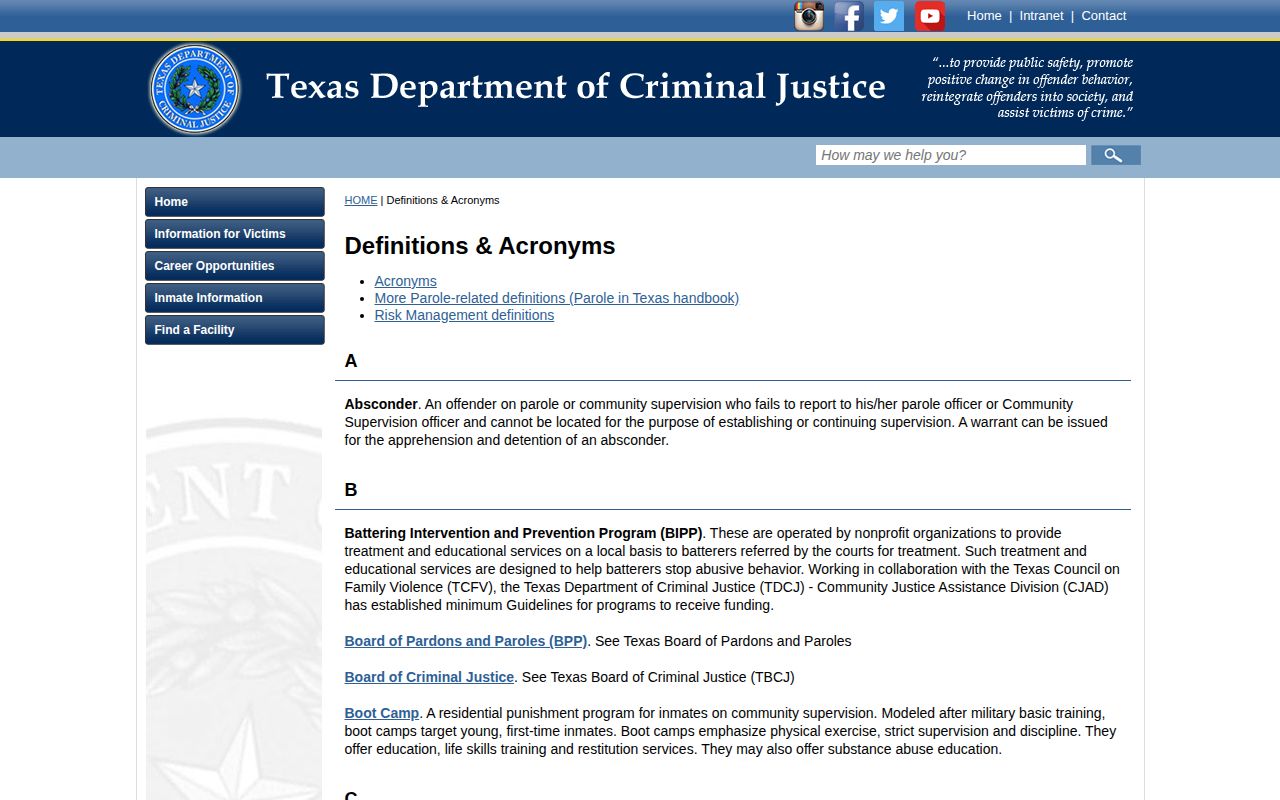
The definition distinguishes a projection from the final release event, which remains subject to case processing.
Why Real County Release Dates Move
A displayed date reflects the information then available to the custodian. New legal or administrative events can require a fresh calculation. Ask which event changed the entry rather than trying to reverse-engineer it from two screenshots.
| Factor | Possible effect | Confirm with |
|---|---|---|
| Good-time classification or loss | Changes credit allowed in a state calculation | TDCJ Classification and Records |
| Parole or mandatory-supervision vote | Can create, condition, delay, or deny a release path | BPP and TDCJ |
| New judgment or stacked sentence | Changes the controlling term | Court and custodian |
| Detainer or hold | May send the person to another agency | Holding and receiving agencies |
| Audit or recalculation | Corrects credits, dates, or sentence structure | Custodian records office |
A detainer is a request or legal basis for another agency to take custody. Release to that agency ends one custody period but does not mean return to the community.
Confirm Real County Actual Release
Near the expected date, check the same source again and contact the physical custodian. Texas VINE may show a custody status or alert for a participating jail. TDCJ IVSS serves eligible registrants for state custody and supervision updates. An alert can be prompt, but it is still a notification layer rather than a certified release record.
Ask the custodian for the actual release date and time, disposition, releasing authority, and destination. If a transfer occurred, obtain the receiving agency's admission or status entry. A TDCJ parole status confirms release from prison into supervision, while discharge means the TDCJ sentence or supervision term ended.
For county custody, the Sheriff record and receiving-jail record may use separate booking numbers. Reconcile both with the court judgment. A roster disappearance alone proves none of these facts.
Real County Jail Good Conduct
County-jail time follows a separate system from TDCJ time. Code of Criminal Procedure article 42.032 permits a sheriff to grant commutation for good conduct, industry, and obedience, up to one day for each day actually served. The statute also addresses forfeiture and a special limit tied to fines and costs.
The key word is “may.” Do not cut a Real County sentence in half as an automatic estimate. Request the actual calendar and conduct ledger from the Sheriff or the outside jail that physically holds the person. Begin with the signed judgment, sentence start, jail credit, and concurrent or consecutive terms. Add only credits the custodian confirms.
The official statute text below shows the county rule in its legal setting.
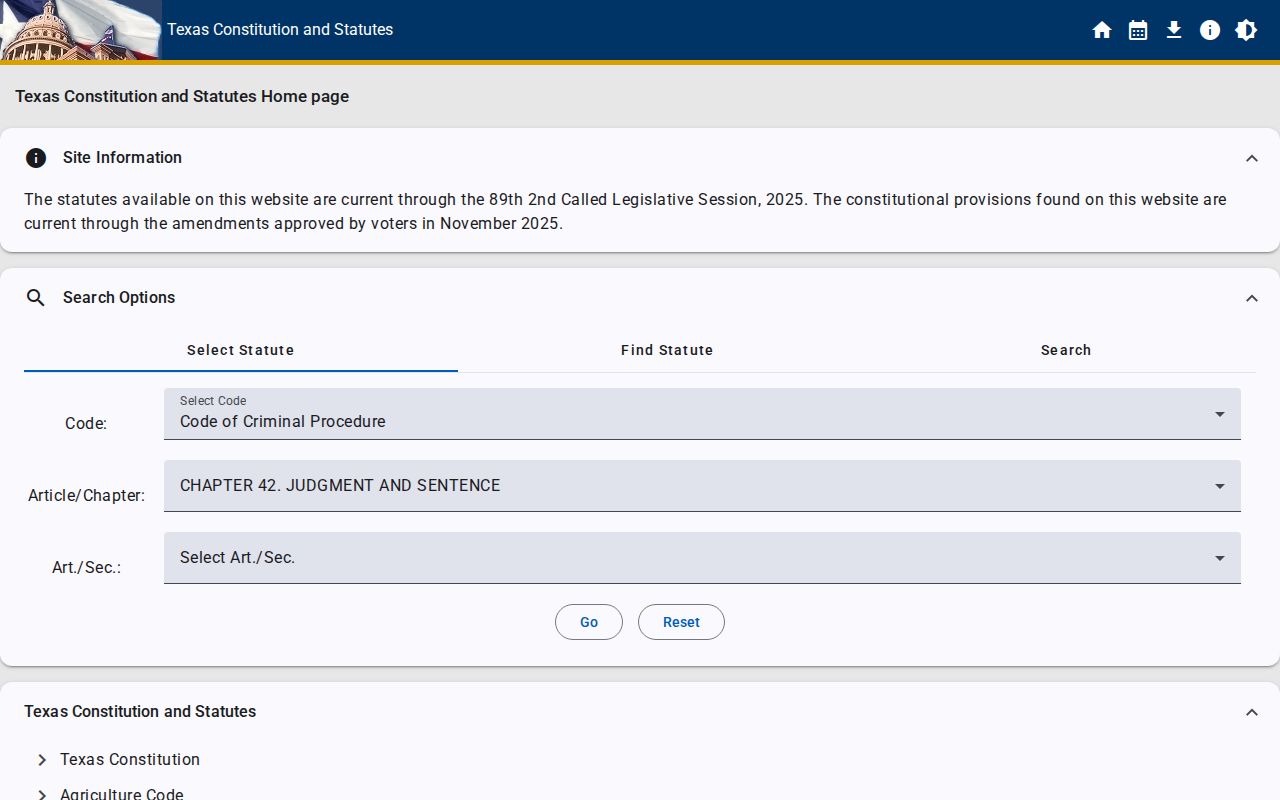
That discretionary county rule is why a TDCJ projected date formula cannot be copied onto a local jail sentence.
Two Real County Release Calculations
Real County release calculations straddle the county and state systems. TDCJ applies offense-date rules, mandatory-supervision eligibility, good-conduct classifications, and board action. A county jail applies the judgment, calendar credit, and any Sheriff-granted commutation under article 42.032.
For either system, check holds and receiving-agency commitments. Then treat the estimate as a date to ask again, not a promise. Article 43.13 generally places sentence-discharge releases between 6 a.m. and 5 p.m., with listed transfer exceptions. It does not set bond-release hours or establish a local exit procedure.
The safest final proof is the actual ledger entry paired with the legal authority. A projection helps plan an inquiry. It does not establish that the gate event occurred.
Real County Sentence Record Inputs
A sound county calculation begins with the signed judgment, not the booking date alone. Record the sentence start, all jail credit, concurrent or consecutive terms, and any fine or cost commitment. Then compare those terms with the jail's calendar and conduct record. The court states the sentence, while the custodian accounts for time served and authorized credit.
Real County may house a person elsewhere. Ask which agency keeps the working time ledger and which enters the release disposition. Real County's file remains important, but the receiving jail may hold the physical custody dates. Resolve any gap before relying on an estimate.
A corrected judgment, stacked sentence, added cause, or changed credit can move the result. Request the latest certified judgment and current computation instead of counting from an old docket entry.
Real County Mandatory Supervision Dates
Mandatory supervision is supervised release, not unconditional discharge. Eligibility depends on the offense and governing law. For later eligible cases, BPP may approve or deny discretionary mandatory supervision. If §508.149 excludes the case, the projection may point to maximum expiration unless parole happens first.
Maximum expiration marks the full term under the state calculation. Parole eligibility may be earlier, but it only opens review. A projected date can move after a board denial, good-time loss, or recalculation. Copy each label exactly from TDCJ.
The final judgment's offense and deadly-weapon finding matter. Do not infer them from an arrest label. Use the law effective on the offense date, and ask TDCJ Classification and Records for the applied computation.
Public Record Search
Sponsored Results